
AI Drafts the Decision. The Operator Catches When It's Confidently Wrong.
Agents draft the focus, budget, and metric calls now. Here is an honest three-column inventory of what the operator job became: what agents own first, what got harder, and what nobody had a job description for before.
The focus decision landed in the ledger on Tuesday morning. An agent had drafted it from the week's evidence. It named the right product, applied cleanly, and sat there for two days before the operator really read it. Nobody was sure that mattered.
That is the moment. Not "AI is getting better at reading the numbers." The moment is: the call is drafted, it looks fine, and nobody quite knows whose judgment it was anymore.
The operator's job did not shrink when agents started drafting the calls. It reorganized around different problems, some familiar in a new form, some genuinely new. What follows is an honest three-column inventory: what agents draft first now, what got harder, and what nobody had a job description for before.
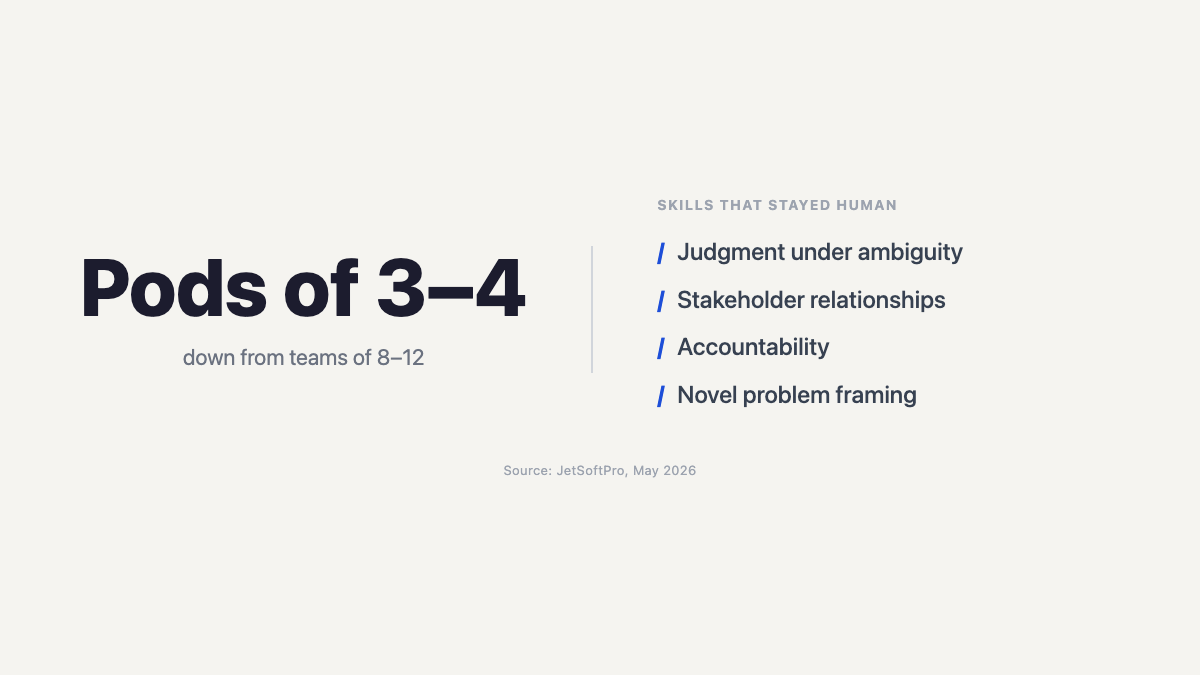
The scale of the underlying shift is worth grounding first. JetSoftPro's May 2026 analysis of AI-first team structures found that traditional teams of 8 to 12 people are being replaced by pods of 3 to 4. [3] Push that compression to its limit and you get the AI-native operator: one person steering several products through agents. Fewer humans means each one accounts for more of what used to be handed off.
What Agents Draft Now, and It's More Than a Summary
Three things now start with agent output rather than a blank weekly review.
The weekly evidence, recorded per product. The synthesis of what product, sales, and marketing actually showed. And the proposed decisions themselves: shift focus to the product with momentum, cut budget on the stalled one, raise the activation KPI on a third. These are the standard opening moves once an operator connects agents to the portfolio. The CMU Integrated Innovation Institute put the principle plainly in January 2026: "AI and vibe coding tools free PMs from routine prototype building, allowing them to focus on what matters most." [2] The routine part is the drafting. The operator who opens the week by assembling the evidence by hand is doing something anachronistic.
In Agimon this division is explicit: agents record the evidence and draft the proposed focus, budget, or metric decision; the operator approves or supersedes. The draft is not the job. It is the thing the job now reviews.
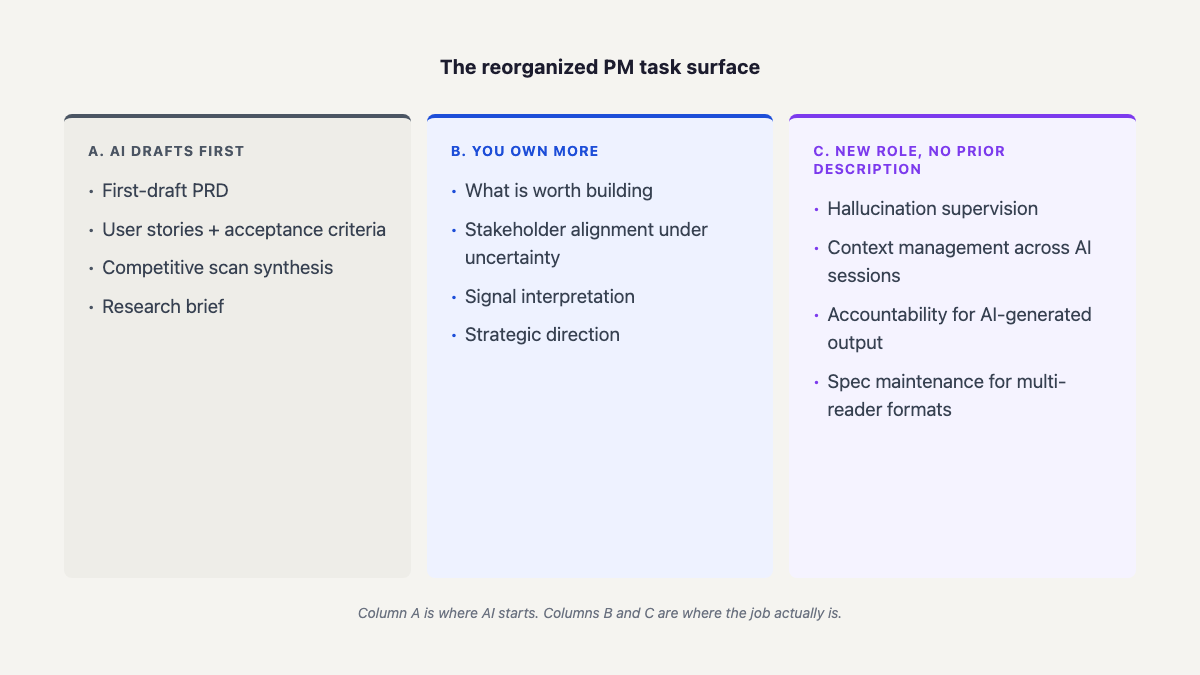
That list is not the interesting part. What stayed harder is.
The Calls That Got More Important
When routine drafting moves to agents, the work that remains is not routine. Two things got structurally more important, not because agents cannot assist, but because the margin for error on each expanded.
The first is knowing what to fund. Atlassian's engineering blog stated the shape of this directly in January 2026: "The scarce resource in software development isn't engineering capacity anymore. It's knowing what is actually worth building." The same piece went further: "When an AI agent can generate a working prototype in an afternoon... The risk is 'should we build this?'" [1] On a portfolio the risk compounds: should we fund this product, this week, over the other two competing for the same budget?
When execution was the bottleneck, wrong bets had natural rate limiters. They took long enough to play out that misalignment surfaced before it drained the runway. When an agent can draft a plausible budget increase in seconds, wrong allocation arrives faster. The cost of building the wrong thing faster is the same cost it always was. The velocity that brings it here is new.
The failure shape is specific enough to name: an operator who approves the budget increase the agent drafted, does not question whether that product deserves the funding over the two it is starving, and discovers a month later that the momentum was noise. That operator did not fail at reading or synthesizing. They failed at the judgment agents cannot supply: whether the bet was worth making at all.
The second is holding a position under uncertainty. JetSoftPro's 2026 analysis listed the human skills that persist at AI-first organizations: "Judgment under ambiguity, architectural decisions, stakeholder relationships, accountability, ethical reasoning, novel problem framing." [3] Every item requires a person willing to hold a call when the evidence is thin and contested. Agents do not hold positions under pressure. They draft the most defensible-looking one and wait for approval.
There is one more column, and the existing job description has no language for it.
The Work Nobody Had a Name for Before
This is the column the old role has no words for.
The first genuinely new task is hallucination supervision. Adrian C. Ott, writing for the CMU Integrated Innovation Institute in January 2026, framed it directly: "Experienced PMs still need to know when an AI model hallucinates and suggests something unrealistic." [2]
The hallucination that trips operators up is not dramatic. It is the agent that confidently drafts a budget increase for a product the operator had already decided to wind down, or a focus shift toward a metric that looks strong only because its evidence is three weeks stale. The draft reads well. It passes a quick scan. It gets approved. The contradiction surfaces later. The cost is not the agent being wrong. The cost is confident wrongness passing a review that had no model for catching it.
The second new task is context management across cycles. Each agent session starts with whatever it can read. Decisions made three weeks ago do not carry forward as intent unless they were recorded as decisions. Someone has to maintain the working company memory: what was decided, what was ruled out, what the current posture and budget on each product are. That someone is the operator, and there was no prior version of this job, because the prior version had the operator making the calls and therefore doing the remembering. What changes when MCP connects agents to the decision layer is the access layer. Which decisions get recorded, and why, is still an operator call.
The third is accountability for agent-drafted decisions. When the operator made the call, ownership was clear. When the agent drafts and the operator approves without interrogating it, the accountability question at the moment a bet goes wrong is genuinely new. An append-only ledger answers part of it: a decision needs more than one reader, and recording who approved what, on what evidence, is how ownership survives the handoff to agents. But the underlying accountability is still the operator's, and it did not exist before the first draft stopped being a human artifact.
That is where the steelman earns its hearing.
The Counterargument Worth Taking Seriously
There is a version of this worth engaging before dismissing it: this is still the same job with a faster research tool.
The steelman runs like this. Operators have always synthesized signals from products, customers, and markets, then made prioritization calls and lived with them. Agents are faster synthesizers. The core skills, judgment, prioritization, knowing what is worth funding, did not change. What changed is the speed of routine reading and drafting. That is an upgrade, not a redefinition.
The argument holds until it hits three breaks.
The accountability break. When the operator made the call and it was wrong, ownership was obvious. When the agent drafts and the operator rubber-stamps, ownership blurs exactly at the moment it matters: when the wrong bet plays out. That gap did not exist before.
The craft-training break. Making the calls was not just a task. It was how operators built judgment: deciding what to fund, what to cut, what to defend. The friction of deciding was also the process of building a model of the portfolio. Remove that friction and the model still has to form somewhere. Whether operators build equivalent judgment by supervising drafts is an open question. It has not run long enough to know.
The context-management break. Maintaining a live, recorded company memory across cycles, so each agent session has what it needs to not contradict the last three, is a new operational skill with no prior description in the job.
Tim Lelek, writing on the Atlassian engineering blog in May 2026, put the implication plainly: "The PMs who thrive won't be the ones who use AI most. They'll be the ones who use it with sharper judgment, who know what's worth building and why." [4] Swap "PMs" for "operators" and it holds. The counterargument's core claim, that the values of the job did not change, is probably right. At the level of what the day looks like, the three breaks are real.
So what is the job, stated cleanly?
What the Job Is Now
Here is the clearest version: the scarce skill moved from making the call to knowing what is worth funding and catching when the machine is confidently wrong.
Agents draft the decision. The operator reads it, catches what the agents did not know about the portfolio, and approves or supersedes. The task moved. The judgment required to verify the call did not shrink. It expanded, because the volume of drafted calls that need review expanded with it, one per product, every week.
Atlassian confirmed in January 2026 that knowing what to build, and by extension what to fund, is now the primary constraint. [1] CMU's January 2026 piece put hallucination supervision at the center of what separates AI-assisted from AI-replaced work. [2] The parts the job handed to agents were not the hard parts. The hard parts are still there, and the list just got three items longer.
If this maps to what you're seeing across your products, send it to someone who's still making every call by hand.
References
- Atlassian. "How AI turns software engineers into product engineers." https://www.atlassian.com/blog/artificial-intelligence/how-ai-turns-software-engineers-into-product-engineers . Published 2026-01-15. Accessed 2026-06-26.
- Ott, Adrian C. "How AI and Vibe Coding Transform Product Management." Carnegie Mellon University, Integrated Innovation Institute. https://www.cmu.edu/iii/about/news/2026/how-ai-and-vibe-coding-transform-product-management.html . Published 2026-01-27. Accessed 2026-06-26.
- JetSoftPro. "AI-First Teams: Roles, Skills, and Expectations Shifting in 2026." https://jetsoftpro.com/blog/ai-first-teams-roles-skills-expectations-shifting-2026 . Published 2026-05-20. Accessed 2026-06-26.
- Lelek, Tim. "The future of product craft: Why AI-native PMs build better products." Atlassian. https://www.atlassian.com/blog/how-we-work/the-future-of-product-craft . Published 2026-05-28. Accessed 2026-06-26.